
Hey guys, forgive me for my long absence from submitting posts here. There is sooo much happening in the world today that I wanted to make sure that my thoughts are in sync with my intentions. I will seek to be more timely as we cross over into the new year.
As I have mentioned in previous posts and video productions, REAL history does not repeat, but it does very often rhyme. America, guided by the United States, is entering a very precarious economic time with its uncontrolled bookkeeping, ever-growing social spending, the expedited devaluing currency, and the coming world de-Dollarization. But if you are even a passive observer of history, particularly the history of the collapse of ancient Rome, you see the storm that is coming just over the horizon that is going to be potentially greater than that of Rome itself.
Few civilizations loom larger than Ancient Rome, and few modern nations rival the United States in power or influence. Yet Rome did not fall overnight. Its fall was seen by many onlookers. Its collapse was slow, expensive, bureaucratic, and fueled by economic mismanagement. Stop me if any of this sounds familiar. Many of the very trends that hollowed out Rome’s economy and led to the demise of Rome, along with its people’s loss of religious grounding, love of country, and internal social division, are now visible in America today. But I want to focus on the economic aspect here.
Currency Debasement: From Silver Coins to Printed Money
Rome’s early denarius contained real silver. But as government spending grew—especially military expenses—emperors reduced silver content, stretching fewer resources over larger promises. Inflation followed. Goods became scarce, prices soared, and trust in currency collapsed.
You cannot drown out the echoes of past disastrous paths of empires. How many of you know that, prior to the 1965 Coinage Act that the dimes and quarters had 90% silver? By 1971, half-dollars dropped from 90% silver → 40% → 0%. While the US dollar is no longer backed by precious metals, its value solely depends on the confidence of the American people and the fiscal restraint of the U.S government. Massive deficit spending, endless stimulus, and unchecked money creation weaken purchasing power just as effectively as shaving silver from coins. Inflation becomes a silent tax on the middle and working classes.
Crushing Taxation and Vanishing Productivity
As Rome’s revenues declined, the state responded predictably: higher taxes. Farmers fled their land. Merchants hid income. Economic productivity slowed as survival replaced innovation.
Today, Americans face an expanding burden of bigger and bigger government — through higher tax rates, through higher inflation, higher regulatory compliance, and indirect costs. Smaller and smaller businesses shoulder paperwork once reserved for large corporations. At the same time much of the populace clamors for more and more government. Federal spending (as a share of GDP) was ~16% in 1965 and ballooned to ~23% in 2024 — an increase of about 7 percentage points, or roughly a 45% rise in the share of GDP the federal government consumes. This can be attributed to long-term growth in entitlement and mandatory spending, episodic crisis spending, i.e., the 2020-21 pandemic and the 2010 Great Recession responses.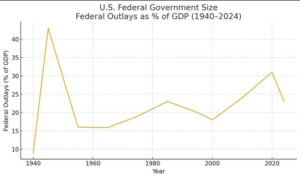 It must be remembered that the government does NOT and can NOT produce wealth; the wealth is created by the people. The government can ONLY redistribute wealth. So like the Roman citizens, many Americans feel trapped: working more produces less, while the state grows larger and more demanding, like the Pac-Man, gobbling up more and more wealth and wealth-production capacity from the people.
Bureaucratic Expansion and State Dependency
Rome’s late empire was bureaucratic beyond reason. Entire classes of citizens were locked into professions to keep tax revenue flowing. The state promised protection and grain—at the cost of freedom. I know, I know, you have not seen this. Right?
The ever-growing appetite of the American people and the U.S Citizens’ hunger for more government dependency and regulation, they inevitably surrender more and more personal freedoms and liberties, and as a result, economic dynamism shrinks. Innovation declines. Risk-taking disappears.
Today, the U.S. leads the world in innovation—but is no longer uncontested, according to the Global Innovation Index. Switzerland, South Korea, and of course, China are all in the rear view mirror – and closing fast. As Americans have been conditioned to surrender their property rights, to accept failure as winning, i.e., participation trophies, and greater government polarization, the access to capital by the private sector shrinks, innovation will in turn go to jurisdictions that are more friendly and accommodating. Rome learned this too late. Empires, in general, do not lose innovation because they lack talent. They lose it because incentives shift from creation to control, i.e., from the hands of the people to the government.
My Country Isn’t Worth It Anymore
History has taught us that civilization survives hardship when citizens believe the country is worth sacrificing for. It’s like your house, your wife or husband, family, or anything that you happen to hold as valuable – once you no longer hold it in high regard or value, you care less what happens to it, and or you care less about who disrespects it, abuses it, or wishes to bring harm to it. When that belief in and love for the country erodes, institutions must rely on coercion, debt, or distraction, i.e more commercial sporting events, i.e., like the gladiators, the lines of staunch moral absolutes become critically blurred —all signs of late decline. Rome shows what happens when the erosion isn’t corrected. Signs are more than clear that the U.S. is rolling down the same road.
Early Roman identity was built on duty, civic sacrifice, and military service as honor. But then, citizenship became a legal status, not a moral bond, loyalty shifted from Rome to local elites, tribes, or paymasters, and soldiers increasingly fought for pay, not patria, i.e., one’s homeland or fatherland. Fast forward to the United States’ version of Rome, back in the day, when I was growing up, I can remember that when any American dared to say anything against America, they literally were taking their lives in their hands. Patriotism was emphasized in the schools, in the media, by the politicians, and, more importantly, it was emphasized in the homes. And it was reflected in the shared national narrative, civic virtue, immigrants wanted to be American, and wanted to assimilate. But, in today’s America, elected government creatures are espousing blatant hostility against American traditions and values, even outright sedition with impunity. Citizenship is increasingly framed as a set of benefits, a platform for grievance, and America is just a geographic location on a map to make money. To be American who can recite the Constitution, proudly display the flag, and or to express reverence for the Founders and the founding of this nation is more likely to be seen as some form of hate speech or xenophobia. Think of this, as a political slogan, “Make America Great Again” has been turned literally into something derogatory in the minds of far too many people in this country.
Rome became just a place where people lived, where it’s ideal’s and principles were stood up for unabashedly, it’s people fought for the principles that it prescribed against all, either ideologically or on the battlefields, and to their hearts believed that there was no other better place, with it’s flaws and imperfections, under the Creator’s heavens, hollowed itself out economically long before the gates fell. America stands at a crossroads. History offers a warning—not a guarantee—but ignoring it may prove costly. At the end of the day, it will be the American people, you and I, who will decide how this empire will be read in the books of history. Will we be seen as a Rome-like empire that forgot that it was the fierce, mighty, and majestic eagle and grew fat and lazy on its laurels? Or will we be seen more like the bald eagle, who chooses not to flee the approaching storm—but we tilted into the wind to gain lift and not only soared above the storm, but became ever more fierce and more powerful learning from the failures of those that came before us. It is up to us.
 REUTERS/Craig Hudson